Showing posts with label 15 August. Show all posts

Aug 14, 2020

Jan gan man , zanda git and vande mataram git MP3 and lyrics see and download here

Jan Gan Man ... ( Rashtra Geet )


जन गण मन अधिनायक जय हे
भारत भाग्य विधाता
पुंजाब सिंध गुजरात मराठा
द्रविड़ उत्कल बंग
विंध्य हिमांचल यमुना गंगा
उच्छल जलधि तरंग
तव शुभ नामे जागे
तव शुभ आशिष मांगे
गाये तव जय गाठा

जन गण मंगल दायक जय हे
भारत भाग्य विधाता
जय हे जय हे जय हे
जय जय जय जय हे

Download Jan Gan Man ....Mp3 Geet : From Here


Vande Mataram Song


वन्दे मातरम्
सुजलां सुफलाम्
मलयजशीतलाम्
शस्यशामलाम्
मातरम्।
वन्दे मातरम्
शुभ्रज्योत्स्नापुलकितयामिनीम्
फुल्लकुसुमितद्रुमदलशोभिनीम्
सुहासिनीं सुमधुर भाषिणीम्
सुखदां वरदां मातरम्।
वन्दे मातरम्।
कोटि-कण्ठ-कल-कल-निनाद-कराले
कोटि-भुजैर्धृत-खरकरवाले,
अबला केन मा एत बले।
बहुबलधारिणीं नमामि तारिणीं
रिपुदलवारिणीं मातरम्।
वन्दे मातरम्।

Download Vande Mataram Mp3 Geet : From Here


Zanda geet Vijayi vishwa Triranga Pyara

विजयी विश्व तिरंगा प्यारा,
झंडा ऊंचा रहे हमारा।

सदा शक्ति बरसाने वाला,
प्रेम सुधा सरसाने वाला,

वीरों को हरषाने वाला,
मातृभूमि का तन-मन सारा।। झंडा...।

स्वतंत्रता के भीषण रण में,
लखकर बढ़े जोश क्षण-क्षण में,

कांपे शत्रु देखकर मन में,
मिट जाए भय संकट सारा।। झंडा...।

इस झंडे के नीचे निर्भय,
लें स्वराज्य यह अविचल निश्चय,

बोलें भारत माता की जय,
स्वतंत्रता हो ध्येय हमारा।। झंडा...।


Download Zanda Geet Mp3 Geet : From Here


Photo credit to Kamlesh Bhai saheb 

Aug 9, 2019

15 August mate upyogi files see here

15 August mate upyogi files see here

Click here for Jan gan man MP3 song

Click here for vande mataram mp3 song

Click here for Vijay vishwa tiranga mp3 song

Click here for desh bhakti PDF

Click here for rastradwaj vise ajani vato PDF

Click here for amantran patrika - 1 2018

Click here for amantran patrika -2 2018

Click here for ujavani

Click here for 15 August vise pdf file

Following Indian rejection of the recommendations in the Simon Commissionan all-party conference was held at Mumbai in May 1928 intended to instil a sense of liberation among people. The conference appointed a drafting committee under Motilal Nehru to draw up a constitution for India. The Kolkata session of the Indian National Congress asked the British government to accord dominion status to India by December 1929, or a countrywide civil disobedience movement would be launched. In the midst of rising political discontent and increasingly violent regional movements, the call for complete sovereignty and an end to British rule began to find increasing grounds for credence with the people. Under the presidency of Jawaharlal at his historic Lahore session in December 1929, the Indian National Congress adopted the objective of complete self-rule. It authorised the Working Committee to launch a civil disobedience movement throughout the country. It was decided that 26 January 1930 should be observed all over India as the Purna Swaraj(complete self-rule) Day. Many Indian political parties and Indian revolutionaries of a wide spectrum united to observe the day with honour and pride.[citation needed]
In March 1931, the Gandhi-Irwin Pact was signed, and the government agreed to set all political prisoners free (although, some of the great revolutionaries were not set free and the death sentence for Bhagat Singh and his two comrades was not taken back which further intensified the agitation against Congress not only outside it also from within). For the next few years, Congress and the government were locked in both conflict and negotiations until what became the Government of India Act 1935 could be hammered out. By then, the rift between the Congress and the Muslim League had become unbridgeable as each pointed the finger at the other acrimoniously. The Muslim League disputed the claim of the Congress to represent all people of India, while the Congress disputed the Muslim League's claim to voice the aspirations of all Muslims.
The Civil Disobedience Movement indicated a new part in the process of the Indian self-rule struggle. As a whole, it became a failure by itself, but it brought the Indian population together, under the Indian National Congress's leadership. The movement made the Indian people strive even more towards self-rule. The movement allowed the Indian community to revive their inner confidence and strength against the British Government. In addition, the movement weakened the authority of the British and aided in the end of the British Empire in India. Overall, the civil disobedience Movement was an essential achievement in the history of Indian self-rule because it persuaded New Delhi of the role of the masses in self-determination
CLICK here for all in one pdf file


Sep 30, 2018

SPIPA COMMIT ONLINE TALIM KEVI RITE LEVI SEE HERE

SPIPA COMMIT ONLINE TALIM KEVI RITE LEVI SEE HERE


Bolikango began his career in the Belgian Congo as a teacher in Catholic schools, and became a prominent member of Congolese society as the leader of a cultural association. He wrote an award-winning novel and worked as a journalist before turning to politics in the late 1950s. Though he held a top communications post in the colonial administration, he became a leader in the push for independence, making him one of the "fathers of independence" in the Congo. The Republic of the Congo became independent in 1960 and Bolikango attempted to organise a national political base that would support his bid for a prestigious office in the new government. He succeeded in establishing the Parti de l'unité nationale and promoted both a united Congo and strong ties with Belgium. Older than most of his contemporaries and commanding significant respect, especially among his Bangala peers, he was seen as the Congo's "elder statesman". Regardless, his attempts to secure a position in the government failed and he became a leading member of the opposition in Parliament.
As the country became embroiled in a domestic crisis, the first government was dislodged and succeeded by several different administrations. Bolikango served as Deputy Prime Minister in one of the new governments before a partial state of stability was reestablished in 1961

Apr 17, 2018

SSA darek school ma Samsung galaxy j2 and thumb scanner apse juo pilot project ma 10 schools ma chalu karyu see here

SSA darek school ma Samsung galaxy j2 and thumb scanner apse juo pilot project ma 10 schools ma chalu karyu see here 

Today, the concept of a salary continues to evolve as part of a system of the total compensation that employers offer to employees. Salary (also now known as fixed pay) is coming to be seen as part of a "total rewards" system which includes bonuses, incentive pay, commissions, benefits and perquisites (or perks), and various other tools which help employers link rewards to an employee's measured performance.[2]
Compensation has evolved considerably. Consider the change from the days of and before the industrial evolution, when a job was held for a lifetime, to the fact that, from 1978 to 2008, individuals who aged from 18 to 44, held an average number of 11 jobs.[11]Compensation has evolved gradually moving away from fixed short-term immediate compensation towards fixed + variable outcomes-based compensation.[citation needed]An increase in knowledge-based work has also led to pursuit of partner (as opposed to employee) like engagement.


March 2018 no pagar and tafavat Ni grant Manjur thayi gayi Che jaldi pagar malse see here latest official paripatra

March 2018 no pagar and tafavat Ni grant Manjur thayi gayi Che jaldi pagar malse see here latest official paripatra 

First paid salaryEdit

While there is no first pay stub for the first work-for-pay exchange, the first salaried work would have required a society advanced enough to have a barter system which allowed for the even exchange of goods or services between tradesmen. More significantly, it presupposes the existence of organized employers—perhaps a government or a religious body—that would facilitate work-for-hire exchanges on a regular enough basis to constitute salaried work. From this, most infer that the first salary would have been paid in a village or city during the Neolithic Revolution, sometime between 10,000 BC and 6000 BC.[2]
A cuneiform inscribed clay tablet dated about 3100 BC provides a record of the daily beerrations for workers in Mesopotamia. The beer is represented by an upright jar with a pointed base. The symbol for rations is a human head eating from a bowl. Round and semicircular impressions represent the measurements.[3]
By the time of the Hebrew Book of Ezra (550 to 450 BC), salt from a person was synonymous with drawing sustenance, taking pay, or being in that person's service. At that time, salt production was strictly controlled by the monarchy or ruling elite. Depending on the translation of Ezra 4:14, the servants of King Artaxerxes I of Persia explain their loyalty variously as "because we are salted with the salt of the palace" or "because we have maintenance from the king" or "because we are responsible to the king".[2]


Apr 16, 2018

Primary teachers Ni TALIM ma samay ferfar babate AAJ NO PARIPATRA SEE HERE official


Primary teachers Ni TALIM ma samay ferfar babate AAJ NO PARIPATRA SEE HERE official


 Iceland, 10 years of primary school (Grunnskóli) are compulsory.
Primary school teaching in Iceland consists of 10 grade levels. These are:
  • 1st grade: 6–7 years
  • 2nd grade: 7–8 years
  • 3rd grade: 8–9 years
  • 4th grade: 9–10 years
  • 5th grade: 10–11 years
  • 6th grade: 11–12 years
  • 7th grade: 12–13 years
  • 8th grade: 13–14 years
  • 9th grade: 14–15 years
  • 10th grade: 15–16 years
education from Class 1 to Class 8. The children in these classes are generally aged between 6 and 15 years. It is the next stage after kindergarten (Pre-Nursery, Nursery, Prep or Lower Kindergarten and Upper Kindergarten). The next stage after primary education is Middle School (Class 7th to 10th). In most schools in North India, children in Classes 1st to 3rd are taught English, Hindi, Mathematics, Environmental Science, and General Knowledge. In class 4th and 5th the environmental science subject is replaced by General Science and Social Studies. However some schools may introduce this concept in Class 3 itself. Some schools may also introduce a third language in Class 5th or even in Class 4th. Sanskrit and local state language are the most common third languages taught in Indian schools. At some places, primary education is labeled as the education of Class 3rd to Class 5th and up to class 2nd as pre-primary education. This is because many new concepts are introduced in this class. Children are taught painting instead of drawing and colouring, exams are taken, and Word Sum Puzzle in maths are introduced along with geometry.
The National Council of Educational Research and Training (NCERT) is the apex body for school education in India.[12] The NCERT provides support and technical assistance to a number of schools in India and oversees many aspects of enforcement of education policies.[13] In India, the various bodies governing school education system are

Apr 13, 2018

17/4/2018 THI START THANAR TALIM NA MUDDA WISE TIME-TABLE BABAT SSA NO LATEST PARIPATRA.


17/4/2018 THI START THANAR TALIM NA MUDDA WISE TIME-TABLE BABAT SSA NO LATEST PARIPATRA.


Teacher education or teacher training refers to the policies, procedures, and provision designed to equip (prospective) teachers with the knowledge, attitudes, behaviors, and skillsthey require to perform their tasks effectively in the classroom, school, and wider community. The professionals who engage in this activity are called teacher educators (or, in some contexts, teacher trainers).
There is a longstanding and ongoing debate about the most appropriate term to describe these activities. The term 'teacher training' (which may give the impression that the activity involves training staff to undertake relatively routine tasks) seems to be losing ground, at least in the U.S., to 'teacher education' (with its connotation of preparing staff for a professional role as a reflective practitioner).[1]

14 apriA na roj school ma ujavani karva babte paripatra latest see activity list

14 apriA na roj school ma ujavani karva babte paripatra latest see activity list

B. R. Ambedkar
Bhimrao Ramji Ambedkar (14 April 1891 – 6 December 1956), popularly known as Babasaheb, was an Indian jurist, economist, politician and social reformer who inspired the Dalit Buddhist Movement and campaigned against social discrimination against Untouchables (Dalits), while also supporting the rights of women and labour.[3][4] He was Independent India's first law minister, the principal architect of the Constitution of Indiaand a founding father of the Republic of India.[5][6][7][8][9]
Bhimrao Ramji Ambedkar
In office
15 August 1947 – September 1951
Prime Minister
Preceded by
Position established
Succeeded by
In office
29 August 1947 – 24 January 1950
In office
1942–1946
Preceded by
Personal details
Born
Died
6 December 1956 (aged 65)
Delhi, India
Political party
Other political
affiliations
Spouse(s)
Ramabai (m. 1906; d. 1935)[1]
Savita Ambedkar (m. 1948)[2]
Profession
Jurist, economist, politician, social reformer
Awards
Bharat Ratna(posthumously in 1990)
Signature
Ambedkar was a prolific student, earning doctorates in economics from both Columbia University and the London School of Economics, and gained a reputation as a scholar for his research in law, economics and political science.[10] In his early career he was an economist, professor, and lawyer. His later life was marked by his political activities; he became involved in campaigning and negotiations for India's independence, publishing journals, advocating political rights and social freedom for Dalits, and contributing significantly to the establishment of the state of India. In 1956 he converted to Buddhism, initiating mass conversions of Dalits.[11]
Popularly, Ambedkar came to be known as Babasaheb as he was a great liberator. “Babasaheb” is a Marathi phrase which roughly translates as “Father-Lord”[12] as Baba means Father and Saheb is called for Lords and it is a name that is used for ambedkar who is a part of Indian history by his people around the country.[12] 
In 1990, the Bharat Ratna, India's highest civilian award, was posthumously conferred upon Ambedkar. Ambedkar's legacy includes numerous memorials and depictions in popular culture.


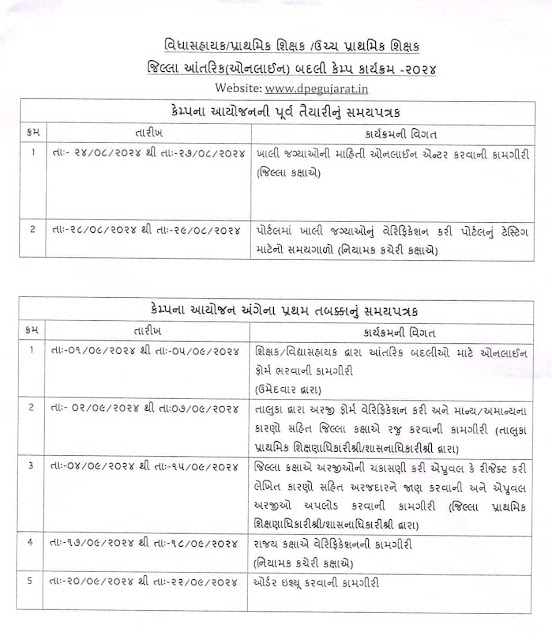
ગુજરાત પ્રાથમિક શિક્ષક બદલી કેમ્પ 2024

આ લિંક પરથી તમે બદલી ઓર્ડર ડાઉનલોડ કરી શકશો.. બદલી હુકમ અહીથી ડાઉનલોડ કરો ઓનલાઇન બદલી હુકમ આજથી બાબતનો  જિઆર અહીથી વાંચો 💥 *બદલી ઓર્ડર ડાઉન...