Nov 25, 2018

Online hajari 24/11/2018 no report students and teachers see here


Online hajari 24/11/2018 no report students and teachers see here

For students see below 

For teachers see below


Wiglaf succeeded Ludeca, who was killed campaigning against East Anglia. His first reign coincided with the continued rise of the rival Anglo-Saxon kingdom of Wessex under Egbert. Egbert drove Wiglaf from the throne in 829, and ruled Mercia directly for a year. Wiglaf recovered the kingdom in 830, probably by force although it may be that Wiglaf remained subject to Egbert's overlordship. Mercia never regained the south-eastern kingdoms, but Berkshire and perhaps Essexcame back into Mercian control. The causes of the fluctuating fortunes of Mercia and Wessex are a matter of speculation, but it may be that Carolingian support influenced both Egbert's ascendancy and the subsequent Mercian recovery. Although Wiglaf appeared to have restored Mercia's independence, the recovery was short-lived, and later in the century Mercia was divided between Wessex and the Vikings. Wiglaf died in about 839, and was eventually succeeded by Beorhtwulf, though one tradition records his son, Wigmund as having reigned briefly. Wiglaf is buried at Repton, near Derby.

Nov 24, 2018

STD -1-8 NU MASVAR VARSHIK MASVAR AYOJAN FOR ALL SUBJECTS

 STD -1-8 NU MASVAR VARSHIK MASVAR AYOJAN FOR ALL SUBJECTS

STD 6-8 MATHS - SCI. SEM -2 PATH AYOJAN

 DHORAN 5-8 NU VARSHIK AYOJAN BADHA SUBJECTS NU MASVAR AYOJAN JUO 

 NEW SYLLABUS MUJAB NU AYOJAN 

SEM -1 AND SEM -2 BANNE NU AYOJAN CHE 

NICHE NI LINK PAR CLICK KARO 

STD 5-8 NU VARSHIK MASVAR AYOJAN 

NICHE NI LINK MA DHORAN 1 ANE 2 NU VARSHIK AYOJAN APEL CHE 

PRAGNA DHORAN 1 ANE 2 MATE NU AYOJAN CHE 

DOWNLOAD KARVA MATE NICHE NI LINK PAR CLICK KARO 

STD 1 ANE 2 NI VARSHIK AYOJAN

STD 1 ANE 2 NI PRAVITI (ACTIVITY) AYOJAN

STD 1 ANE 2 NI ADHYAN NISHAPATI APEL CHE 

DHORAN -1 ANE 2 NU VARSHIK AYOJAN 


DHORAN 3- 8 NU VARSHIK PATH AYOJAN 

 SEM 1 ANE SEM 2 NU PATH AYOJAN APEL CHE NEW 2018-19 

CLICK HERE FOR DOWNLOAD 3-8 AYOJAN

Nayab chitnis paper and solution see here

CLICK HERE FOR VIEW paper

https://goo.gl/Rg4tV

Nayab chitnis paper and solution see here

CLICK HERE FOR solution

Three factors dictated the type of locomotive that could run on the South Eastern and Chatham Railway (SECR): increased freight and passenger train loadings, poor track quality, and weak, lightly built bridges.[5] An increasing number of passengers used the SECR to reach the cross-Channel ferries at Dover and Folkestone between 1910 and 1913, and heavy goods trains between Tonbridge and Hither Green marshalling yardstretched the capabilities of existing locomotives and infrastructure.[6] On the lines of the former London, Chatham and Dover Railway (LCDR), flint beach pebbles on a bed of ash had been used for ballast.[7][8]Conventional track ballast has irregular shapes that "lock" together to keep the track in place, whereas the smooth pebbles used by the LCDR failed to prevent track movement under strain.[7] The economies in construction meant that only locomotives with low axle loadings could run safely on the track.[9]These restrictions meant that the SECR was unable to follow a coherent locomotive strategy that reduced costs and increased serviceability. The railway's Operating Department had to use mismatched classes of underpowered and obsolete 4-4-0 and 0-6-0locomotives because they could run within the restrictions imposed by the infrastructure.[10] This meant frequent double-heading that increased operational costs.[9]
Richard Maunsell was appointed CME of the SECR in 1913, following the retirement of Harry Wainwright due to ill health. Wainwright left a legacy of competent but unspectacular locomotives that struggled to cope with the increased train lengths and loadings.[5]Maunsell took control of the short-term situation by improving existing designs, and he introduced new engines to progressively replace obsolete classes.[11] New designs could also cut costs on the SECR, as one capable mixed-traffic locomotive could undertake the work of two separate passenger or freight types.[9] The first new design was to become Maunsell's N class 2-6-0.


Nov 23, 2018

Mukhya sevika nu aaj nu paper see HERE and solution

Mukhya sevika nu aaj nu paper see HERE and solution

CLICK HERE FOR paper

Solution pan aaj post ma mukvama avse to save kari rakho aa link
https://goo.gl/Rg4tVx

CLICK HERE FOR SOLUTION

Nico Ditch was constructed some time between the end of Roman rule in Britain in the early 5th century and the Norman conquest in 1066. Its original purpose is unclear, but it may have been used as a defensive fortification or as an administrative boundary. It possibly marked a 7th-century boundary for the expansionist Anglo-Saxons, or it may have been a late 8th or early 9th century boundary marker between the kingdoms of Mercia and Northumbria.[4] In the early medieval period, the Anglo-Saxon kingdoms of Northumbria, Mercia and Wessex struggled for control over North West England,[5] along with the Britons and the Danes. Whatever its earlier use, the ditch has been used as a boundary since at least the Middle Ages.[6]
Legend has it that Nico Ditch was completed in a single night by the inhabitants of Manchester, as a protection against Viking invaders in 869–870; Manchester may have been sacked by the Danes in 870.[7] It was said that each man had an allocated area to construct, and was required to dig his section of the ditch and build a bank equal to his own height.[4] According to 19th century folklore, the ditch was the site of a battle between Saxons and Danes; the battle was supposed to have given the nearby towns of Gorton and Reddish their names, from "Gore Town" and "Red-Ditch",[8][9] but the idea has been dismissed by historians as a "popular fancy".[10] The names derive from "dirty farmstead" and "reedy ditch" respectively.[11]

A map of Nico Ditch between Reddish and Slade Hallin Longsight, printed in 1895. This section of the ditch is still evident.
Antiquarians and historians have been interested in the ditch since the 19th century, but much of its course has been built over. Between 1990 and 1997, the University of Manchester Archaeological Unit excavated sections of the ditch in Denton, Reddish, Levenshulme and Platt Fields, in an attempt to determine its age and purpose. Although no date was established for the ditch's construction, the investigations revealed that the bank to the north of the ditch is of 20th century origin. Together with the ditch's profile, which is U-shaped rather than the V-shape typically used in military ditches and defences, this suggests that the purpose of the earthwork was to mark a territorial boundary.[1] The conclusion of the project was that the ditch was probably a boundary marker

Nov 22, 2018

Shala bahar na balko no serve karva babte paripatra see here

CLICK HERE FOR DOWNLOAD

Shala bahar na balko no serve karva babte paripatra see here

The show centers on FBI special agents Fox Mulder (David Duchovny) and Dana Scully(Gillian Anderson), who work on cases linked to the paranormal, called X-Files. Mulder is a believer in the paranormal, the skeptical Scully has been assigned to debunk his work, and the two have developed a close friendship. In this episode, Mulder races to a luxury passenger liner which has mysteriously appeared in the Bermuda Triangle. Once there, he realizes he has traveled back in time to September 3, 1939—the outbreak of World War II. German soldiers have boarded the ship in search of "Thor's Hammer", something that could ensure victory in the coming conflict. Scully, after being informed of Mulder's disappearance by The Lone Gunmen, rushes through the J. Edgar Hoover Building, looking for someone who can help find her missing partner.
"Triangle" is filmed in a unique style. Inspired by the 1948 Alfred Hitchcock film Rope, many scenes were edited to appear as single takes. In addition, "Triangle" features the main and recurring cast members such as Anderson, William B. DavisChris OwensJames Pickens Jr. and Mitch Pileggi, who played their contemporary characters as well as distinctly different characters from 1939 on board the luxury liner. Several of the episode's themes have been critically examined, such as the concept of "dream-nazis", the appearance of modern characters portraying those from the past, and the ramification that the entire episode was a dream.

45 mu maths- SCIENCE exhibition mate nu amatran Patrika

CLICK HERE FOR VIEW Patrika

SEE HERE FOR VIEW paripatra

45 mu maths- SCIENCE exhibition mate nu amatran  Patrika

The awards were first established in 1993, and presented in 1994, in conjunction with the United Nations declared International Decade of the World's Indigenous People. The awards are intended to celebrate and encourage excellence in the Indigenous community.[2]Awards may be presented in a variety of categories, depending on the particular achievements of Aboriginal people in the nominating period — 14 awards[3] are presented each year including one for Lifetime Achievement and three special Youth Awards, one each for First NationsInuit and Métis, that comes with a cash prize of $10,000 and 10 career categories with not all individual career categories necessarily presented annually. To be eligible an individual must be of either First Nations, Inuit, or Métis heritage. Additionally they must demonstrate outstanding career achievement, and be a permanent Canadian resident or be Canadian born. The awards are broadcast annually on the Global Television Network and the Aboriginal Peoples Television Network(APTN). Since 1985 Indspire through its Education Program has awarded more than $87-million in scholarships and bursaries to more than 25,00 First Nations, Inuit and Métis students nationwide

Inspire award mate students nu list for all districts

Click here to view

Inspire award mate students nu list for all districts

The awards were first established in 1993, and presented in 1994, in conjunction with the United Nations declared International Decade of the World's Indigenous People. The awards are intended to celebrate and encourage excellence in the Indigenous community.[2]Awards may be presented in a variety of categories, depending on the particular achievements of Aboriginal people in the nominating period — 14 awards[3] are presented each year including one for Lifetime Achievement and three special Youth Awards, one each for First NationsInuit and Métis, that comes with a cash prize of $10,000 and 10 career categories with not all individual career categories necessarily presented annually. To be eligible an individual must be of either First Nations, Inuit, or Métis heritage. Additionally they must demonstrate outstanding career achievement, and be a permanent Canadian resident or be Canadian born. The awards are broadcast annually on the Global Television Network and the Aboriginal Peoples Television Network(APTN). Since 1985 Indspire through its Education Program has awarded more than $87-million in scholarships and bursaries to more than 25,00 First Nations, Inuit and Métis students nationwide

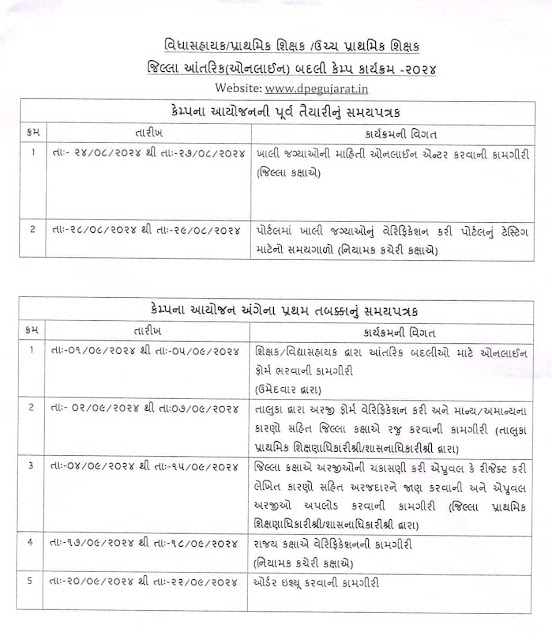
ગુજરાત પ્રાથમિક શિક્ષક બદલી કેમ્પ 2024

આ લિંક પરથી તમે બદલી ઓર્ડર ડાઉનલોડ કરી શકશો.. બદલી હુકમ અહીથી ડાઉનલોડ કરો ઓનલાઇન બદલી હુકમ આજથી બાબતનો  જિઆર અહીથી વાંચો 💥 *બદલી ઓર્ડર ડાઉન...