Jul 12, 2018

Gunostav-8 result declared see here

Gunostav-8 result declared see here .

MAHESANA JILLA NU RESULT

Scholarly consensus is emerging that what is required of teachers can be grouped under three headings:
knowledge (such as: the subject matter itself and knowledge about how to teach it, curricular knowledge, knowledge about the educational sciences, psychology, assessment etc.)
craft skills (such as lesson planning, using teaching technologies, managing students and groups, monitoring and assessing learning etc.) and
dispositions (such as essential values and attitudes, beliefs and commitment

Shishya vruti ma online updation 2018-19 kevi rite karvu teni sampurn samaj sew here in gujarati bhasha

Click here for how to process in gujarati bhasha

Shishya vruti ma online updatati kevi rite karvu teni sampurn samaj sew here in gujarati bhasha

Teaching is a highly complex activity.[2] This is in part because teaching is a social practice, that takes place in a specific context (time, place, culture, socio-political-economic situation etc.) and therefore reflects the values of that specific context.[3] Factors that influence what is expected (or required) of teachers include history and tradition, social views about the purpose of education, accepted theories about learning, etc.[4]

Competences

The competencies required by a teacher are affected by the different ways in which the role is understood around the world. Broadly, there seem to be four models:
the teacher as manager of instruction;
the teacher as caring person;
the teacher as expert learner; and
the teacher as cultural and civic person.[5]
The OECD has argued that it is necessary to develop a shared definition of the skills and knowledge required by teachers, in order to guide teachers' career-long education and professional development.[6] Some evidence-based international discussions have tried to reach such a common understanding. For example, the European Union has identified three broad areas of competences that teachers require:

Pragna samput download in pdf file suparb in gujarati bhasha

Click here to see

Pragna samput download in pdf file suparb in gujarati bhasha

The competencies required by a teacher are affected by the different ways in which the role is understood around the world. Broadly, there seem to be four models:
the teacher as manager of instruction;
the teacher as caring person;
the teacher as expert learner; and
the teacher as cultural and civic person.[5]
The OECD has argued that it is necessary to develop a shared definition of the skills and knowledge required by teachers, in order to guide teachers' career-long education and professional development.[6] Some evidence-based international discussions have tried to reach such a common understanding. For example, the European Union has identified three broad areas of competences that teachers require:
Working with others
Working with knowledge, technology and information, and
Working in and with society.[7]
Scholarly consensus is emerging that what is required of teachers can be grouped under three headings:
knowledge (such as: the subject matter itself and knowledge about how to teach it, curricular knowledge, knowledge about the educational sciences, psychology, assessment etc.)


Jul 11, 2018

RTE act mujab shala na samay ma vadharo karva BABATE PARIPATRA see here

RTE act mujab shala na samay ma vadharo karva BABATE PARIPATRA see here

Teaching is a highly complex activity.[2] This is in part because teaching is a social practice, that takes place in a specific context (time, place, culture, socio-political-economic situation etc.) and therefore reflects the values of that specific context.[3] Factors that influence what is expected (or required) of teachers include history and tradition, social views about the purpose of education, accepted theories about learning, etc.[4]

Competences

The competencies required by a teacher are affected by the different ways in which the role is understood around the world. Broadly, there seem to be four models:
the teacher as manager of instruction;
the teacher as caring person;
the teacher as expert learner; and
the teacher as cultural and civic person.[5]
The OECD has argued that it is necessary to develop a shared definition of the skills and knowledge required by teachers, in order to guide teachers' career-long education and professional development.[6] Some evidence-based international discussions have tried to reach such a common understanding. For example, the European Union has identified three broad areas of competences that teachers require:


Jul 10, 2018

"Mina ni duniya" karyakram ma avti varta no sangrah see and LISTEN

CLICK HERE TO LISTEN

"Mina ni duniya"  karyakram ma avti varta no sangrah see and LISTEN

The Meena Radio Programme is an entertainment-education programme that was developed by UNICEF in partnership with the Department of Education, Government of Uttar Pradesh (GoUP) and its Sarva Shiksha Abhiyan (SSA) State Project Office. The programme’s aims at the time of inception included:
  1. To cause a measurable change in knowledge, attitude and intent on key child rights issues, and issues related to child health, sanitation, and hand hygiene amongst students.
  2. To address existing social norms that prevent 100% enrolment, retention and completion of upper primary education for girl children.
  3. To improve skills amongst children reached through the programme, in problem solving, negotiation, and prosocial behaviour.
  4. To model and endorse the concept of child friendly schools, and life skill-based education.
The Meena Radio Programme was designed as a combination of mass media and interpersonal communication. The 15-minute radio programme was developed comprising of three segments: songs, stories and games. It was decided to include the radio programme as a part of the structured school time-table for middle school students. This ensured that all the students could listen to the programme and engage in a post broadcast teacher-facilitated discussion on the key messages of the day’s episode.
The Meena Radio Programme was piloted in 9 districts in Uttar Pradesh (UP) in 2010 and expanded to the rest of the state in 2012. The programme was introduced in Andhra Pradesh (AP) and Madhya Pradesh (MP) in 2012.
UNICEF engaged Deloitte Touché Tohmatsu India Private Ltd. (Deloitte) to carry out an evaluation of the Meena Radio Programme in UP, AP, and MP.


Jul 9, 2018

Gunostav -8 na parinam jaher see official notification

Gunostav -8 na parinam jaher see official notification
teacher (also called a school teacher or, in some contexts, an educator) is a person who helps others to acquire knowledge, competences or values.
Informally the role of teacher may be taken on by anyone (e.g. when showing a colleague how to perform a specific task). In some countries, teaching young people of school age may be carried out in an informal setting, such as within the family (homeschooling), rather than in a formal setting such as a school or college. Some other professions may involve a significant amount of teaching (e.g. youth worker, pastor).
In most countries, formal teaching of students is usually carried out by paid professional teachers. This article focuses on those who are employed, as their main role, to teach others in a formal education context, such as at a school or other place of initialformal education or training.


Chalo Aadarsh baniye antargat talim ma darek school mathi ek sixak ne hajar rehva babate paripatra

Click here to read

Chalo Aadarsh baniye antargat talim ma darek school mathi ek sixak ne hajar rehva babate paripatra

teacher (also called a school teacher or, in some contexts, an educator) is a person who helps others to acquire knowledge, competences or values.
Informally the role of teacher may be taken on by anyone (e.g. when showing a colleague how to perform a specific task). In some countries, teaching young people of school age may be carried out in an informal setting, such as within the family (homeschooling), rather than in a formal setting such as a school or college. Some other professions may involve a significant amount of teaching (e.g. youth worker, pastor).
In most countries, formal teaching of students is usually carried out by paid professional teachers. This article focuses on those who are employed, as their main role, to teach others in a formal education context, such as at a school or other place of initialformal education or training.

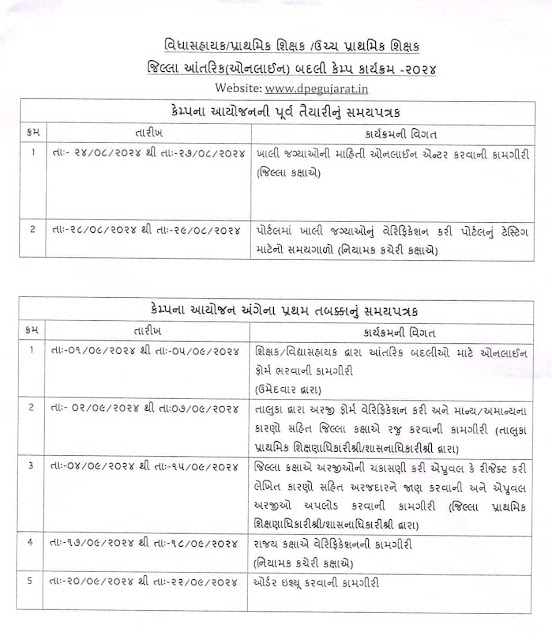
ગુજરાત પ્રાથમિક શિક્ષક બદલી કેમ્પ 2024

આ લિંક પરથી તમે બદલી ઓર્ડર ડાઉનલોડ કરી શકશો.. બદલી હુકમ અહીથી ડાઉનલોડ કરો ઓનલાઇન બદલી હુકમ આજથી બાબતનો  જિઆર અહીથી વાંચો 💥 *બદલી ઓર્ડર ડાઉન...